How to Maintain Press Brakes for Long-Term Stable Operation
Published:2026-08-27
Browse:
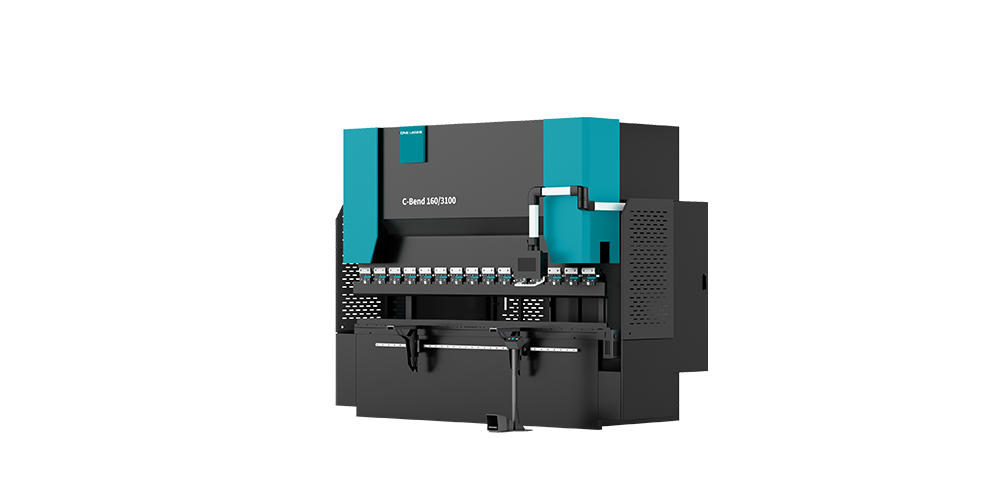
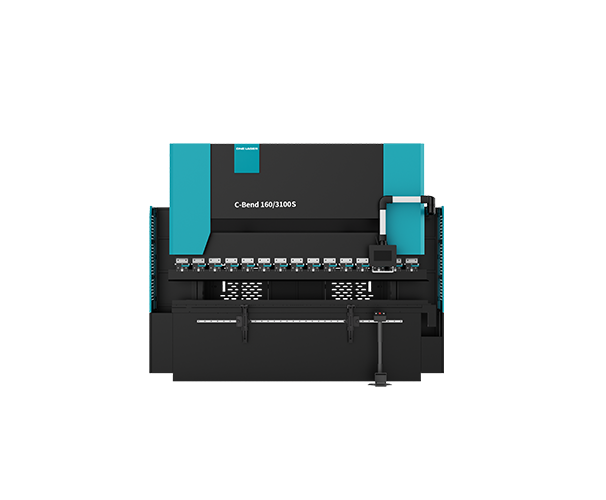
Press brakes are essential precision equipment in sheet metal manufacturing, responsible for shaping metal sheets into required angles and structures. The stability, accuracy, and service life of press brakes heavily depend on daily and periodic maintenance. Without proper upkeep, machines are prone to angle deviation, hydraulic leakage, tool wear, and electrical failures, which lead to low productivity, poor product quality, and high repair costs. Scientific and standardized maintenance is critical to maximizing machine performance and extending equipment lifespan.
First, daily cleaning and environmental maintenance form the foundation of press brake upkeep. During continuous bending operations, metal dust, iron scraps, oil residues, and workshop impurities easily accumulate on the machine surface, tooling, and sliding rails. If left uncleaned, these contaminants cause abrasion on moving parts and scratch mold surfaces. Operators should clean the worktable, punch and die, back gauge, and guide rails before and after each shift. In addition, the working environment must be kept dry and dust-free. Humidity can corrode metal components and damage electrical circuits, while excessive dust may affect sensor sensitivity.
Second, regular hydraulic system maintenance ensures stable machine power output. Most industrial press brakes rely on hydraulic transmission to provide bending force. Hydraulic oil contamination, oil deterioration, insufficient oil level, or blocked filters are common causes of slow ram movement, unstable pressure, and oil leakage. Workers should check the hydraulic oil level daily and replenish qualified hydraulic oil when necessary. It is essential to replace hydraulic oil and clean oil filters every six months to one year according to operating frequency. Regular inspection of hydraulic pipes, seals, and valves can prevent oil leakage and pressure loss, maintaining consistent bending tonnage.
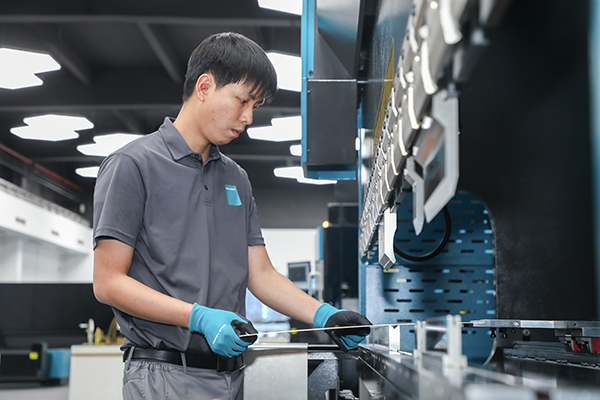
Third, tooling maintenance directly guarantees processing quality. Punches and dies are core wearing parts. Long-term friction causes surface scratches, edge wear, and deformation, resulting in defective bending workpieces. Operators must clean and lubricate molds regularly to reduce friction loss. Worn tool edges should be polished timely, and severely damaged molds need immediate replacement. Furthermore, operators must select matched molds according to sheet thickness to avoid overloading and abnormal tool wear.
Fourth, electrical and precision component maintenance cannot be ignored. CNC controllers, encoders, sensors, and servo motors determine bending accuracy. Operators should regularly check circuit connections to prevent loose wires and short circuits. Dust inside the electrical cabinet must be removed periodically to avoid component overheating and signal failure. Professional technicians should calibrate back gauge positioning accuracy and ram parallelism quarterly to eliminate cumulative dimensional errors.
Finally, standardized operating habits serve as invisible maintenance. Overloading, sudden emergency stops, and unparameterized blind operation will accelerate machine aging. Training operators to follow standard procedures effectively reduces unnecessary equipment loss.
In summary, systematic maintenance including daily cleaning, hydraulic protection, tool upkeep, electrical inspection, and regular calibration can keep press brakes in optimal condition. Good maintenance habits reduce failure rates, improve production efficiency, and greatly extend the service life of press brake equipment.